
Ripple Partner Arf Brings Its $10 Billion Payments Lending Business to the XRP Ledger
Swiss payments lender Arf is partnering with Ripple to bring its $10 billion lending business to the XRP Ledger, utilizing the RLUSD stablecoin to provide short-term working capital for cross-border payments pending validator votes.

Swiss payments lender Arf announced on Thursday, October 22, that it is teaming up with Ripple to lend the RLUSD stablecoin to licensed cross-border payment providers on the XRP Ledger. This arrangement supplies them with working capital while their payments settle. Although it marked the biggest XRP news of the week, XRP dipped 4% that same day, and the onchain lending utilities Arf intends to utilize are still awaiting the necessary validator votes to go live.
XRP trades at $1.32 on Friday, reflecting a 0.9% decrease over 24 hours and a 17% drop over the past month. So what capabilities does Arf actually introduce, and when will the XRP Ledger’s lending protocol launch?
Arf is bringing settlement liquidity to the @XRP Ledger.
Cross-border payments move trillions of dollars every year, but the capital needed to move that money often remains tied up across markets.
That’s why we’re partnering with @Ripple to bring RLUSD-powered settlement… pic.twitter.com/M9RQqdITse
— Arf (@arf_one) October 22, 2026
XRP News: What Is Arf Bringing to the XRP Ledger?
It provides short-term loans tailored for payment companies. Remittance or card firms sending funds overseas frequently need to pay out at the destination before the sender’s actual money arrives. This gap requires readily available cash across multiple markets, whereas setting up traditional bank credit lines can require months.
Arf’s settlement liquidity bridges this gap using stablecoin loans typically repaid within one to five days, right after the payment successfully settles. Based in Zug, the Swiss-regulated financial institution handles roughly $10 billion annually in settlement volume, with capital turning over four times each month.
During the initial phase, Arf will lend RLUSD straight on the XRP Ledger. The participating payment firms do not need to interact with blockchain technology directly, as Arf manages the fiat-to-stablecoin conversions through its own bank accounts.
What Are XLS-65 and XLS-66, and When Do They Go Live?
These serve as the native lending tools of the XRP Ledger. XLS-65 establishes Single Asset Vaults, allowing lenders to pool a single asset like RLUSD. Meanwhile, XLS-66 acts as the Lending Protocol, enabling that pooled capital to be distributed as fixed-term loans. Arf will continue managing credit checks offchain, while the funds themselves will be held and lent onchain.
XRP Ledger commentator Vet characterized the development as “XRP Ledger powering cross-border payments with on-chain credit,” adding that it “fixes tradFi inefficiencies.”
Pay attention.
XRP Ledger powering cross border payments with on chain credit! It brings everything together and fixes tradFi inefficiencies.
What is the settlement liquidity Arf is bringing and what does this mean for XRP, XRP Ledger and RLUSD. Especially for XLS-66 and… https://t.co/gTp5p4dyIg pic.twitter.com/zbu3gFi2L2
— Vet (@Vet_X0) October 22, 2026
Neither tool is currently active. Amendments require backing from 80% of trusted validators over a two-week period to become operational. According to the XRP Ledger amendment tracker, the Lending Protocol holds 17 out of 32 validator votes, while Single Asset Vaults sit at 19, falling short of the 25 votes required.
Until those thresholds are met, Arf will operate the program via direct loans, migrating to the native protocol once XLS-65 and XLS-66 are activated on the mainnet.
How does this benefit XRP? RLUSD stands to gain the most. It serves as the primary currency for every loan from payout through repayment, relying on its home blockchain network. The supply of RLUSD on the XRP Ledger has decreased to approximately $939.82 million down from $1.05 billion a week ago, whereas its Ethereum-based supply has expanded to $1.46 billion.
For XRP, the connection is indirect. Every transaction on the XRP Ledger incurs a minor fee paid in XRP, and user accounts alongside objects like vaults and loans lock up XRP reserves. Loans settled every few days generate repeated transaction activity. However, because XRP Ledger transaction fees are mere fractions of a cent, the resulting impact on demand remains limited unless transaction volumes scale significantly. Arf itself characterizes XRP’s function as supporting “the underlying network activity.”
DISCOVER: XRP Traders Cut Binance Leverage by a Quarter in Under a Month, and the Ones Left Are Leaning Long
XRP Price Analysis: Can XRP Hold $1.30?
The announcement failed to spur an immediate price rally. XRP climbed to $1.3992 on Wednesday—marking a one-week high—before declining 4.1% on Thursday as Arf’s news broke, wrapping up the session at $1.3094. It has since drifted back to about $1.32, remaining confined to the trading range maintained since mid-October.

On the upside, the $1.332 to $1.353 zone presents the initial resistance test, aligning with where the 4-hour 50 EMA intersects the area breached during Thursday’s sell-off. Beyond that lies a more substantial hurdle: the daily 50 and 200 EMAs clustered between $1.371 and $1.374. XRP has closed below both indicators every day since October 12, and Wednesday’s upward push above them proved short-lived within hours.
On the downside, support between $1.30 and $1.31 has held firm through Thursday and Friday. Breaking below this region would place the October 18 low of $1.2562 back into focus, which marked the absolute trough of the month’s downward movement. Conversely, a daily close higher than $1.374 would clear a path toward Wednesday’s peak of $1.3992 and subsequently $1.43.
The Arf partnership represents significant XRP news that extends beyond short-term price fluctuations, providing the XRP Ledger with an authentic lending client driving actual payment volume. The extent to which this commercial activity transitions fully onchain now depends on securing eight additional validator votes.
EXPLORE: Best Crypto Presales With Asymmetric Upside in the Current Market
Follow 99Bitcoins on X For the Latest Market Updates and Subscribe on YouTube For Daily Expert Market Analysis.
Frequently Asked Questions
4 questions01What is the partnership between Arf and Ripple?
Arf is partnering with Ripple to lend the RLUSD stablecoin to licensed cross-border payment providers on the XRP Ledger, supplying necessary working capital while transactions settle.
02What are XLS-65 and XLS-66?
XLS-65 and XLS-66 are the native lending tools of the XRP Ledger. XLS-65 implements Single Asset Vaults for pooling assets like RLUSD, while XLS-66 serves as the Lending Protocol for issuing fixed-term loans from those pools.
03Are the XRP Ledger lending protocols live yet?
No. The amendments require 80% support from trusted validators over a two-week period to activate. Currently, the Lending Protocol holds 17 of 32 votes and Single Asset Vaults hold 19, leaving them short of the required 25 votes.
04How does this partnership impact the price of XRP?
The impact is indirect. Transactions generate tiny fee burns in XRP, and structures like vaults and loans lock up XRP reserves, but the primary network beneficiary of the lending activity is the RLUSD stablecoin.
Related stories
Google Gemini AI Predicts a Historic Move for SUI by 2027
Something potentially explosive could be building for Sui (SUI) by January 1, 2027, according to Gemini. Google Gemini…
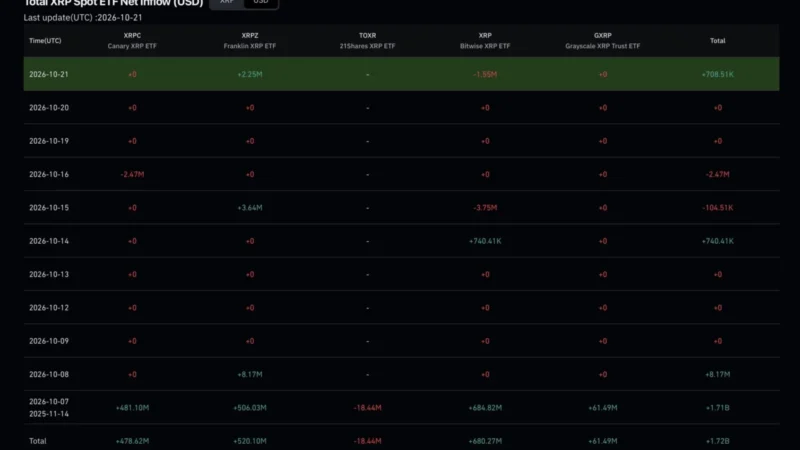
Franklin’s XRP ETF Buys $2.25 Million as Bitwise’s Fund Sells: Is Wall Street Losing Interest in XRP, or Just Waiting?
U.S. spot XRP ETFs recorded minor net inflows bolstered by Franklin Templeton's XRPZ, while Bitwise experienced outflows. Meanwhile,…

OCC GENIUS Act Rules Could Reshape the US Stablecoin Market
The US Office of the Comptroller of the Currency has finalized regulations for the GENIUS Act, establishing federal…
Claude AI Predicts Something Big Could be on the Way for Solana
Anthropic's Claude AI forecasts a speculative price surge for Solana by January 1, 2027, driven by a hypothetical…