
OCC GENIUS Act Rules Could Reshape the US Stablecoin Market
The US Office of the Comptroller of the Currency has finalized regulations for the GENIUS Act, establishing federal standards for stablecoin issuers, reserve backing, and risk management ahead of the January 2027 implementation date.
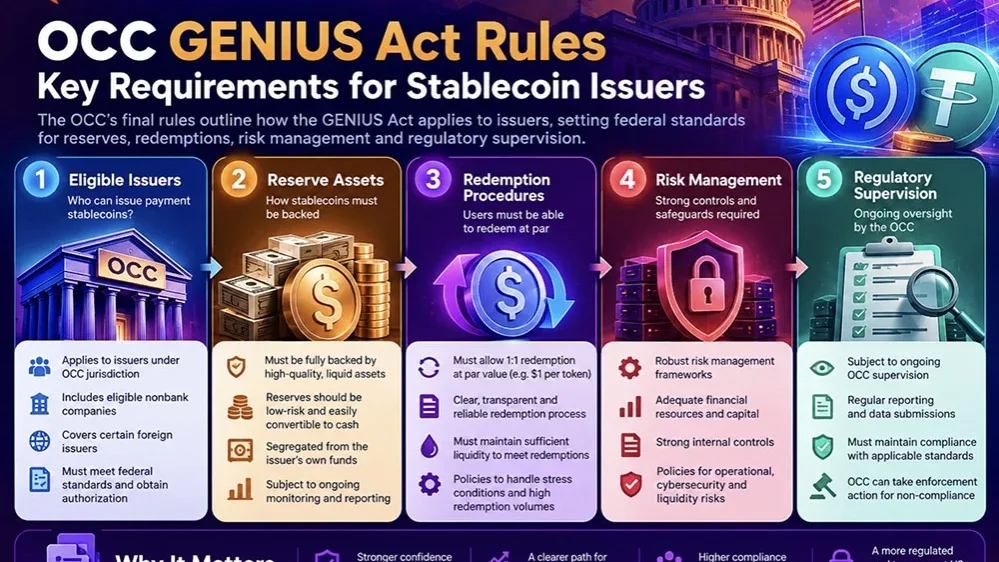
The US Office of the Comptroller of the Currency (OCC) has finalized regulations enforcing the GENIUS Act, setting federal standards for stablecoin issuers, reserve backing, redemption processes, and risk management. These guidelines become effective on January 18, 2027, providing firms with a structured roadmap for operating within the American payment stablecoin sector.
Following months of dialogue with digital asset firms, community lenders, industry associations, and scholars, the OCC published the final regulation on October 21. The framework additionally addresses specific custody operations managed by financial institutions regulated by the agency.
BREAKING: Trump-signed GENIUS Act gets its FIRST final stablecoin rule ahead of Jan 2027 implementation.
The OCC eases its approach to stablecoin rewards, dropping language that presumed certain third-party arrangements were unlawful.
Those rewards will now face case-by-case… pic.twitter.com/4VVsmDc2ij
— Coin Bureau (@coinbureau) October 21, 2026
The release of the OCC GENIUS Act regulations represents a major milestone in turning the legislation into action. Stablecoin providers must now pivot their attention toward satisfying compliance mandates, obtaining authorization, and gearing up for the updated structure.
DISCOVER: BTC USD ETF Rebound Was Led Almost Entirely by BlackRock’s IBIT Fund
The New OCC GENIUS Act Rules Set Stablecoin Standards
Originally signed into law on July 18, 2025, the GENIUS Act instituted a federal structure for payment stablecoins. The final OCC rules outline how the statute will govern entities under its oversight, which includes eligible nonbank companies alongside select international issuers.
The mandates outline strict criteria for reserve holdings, redemption protocols, risk mitigation, and oversight. Entities must prove that their operational capacities, financial standing, and internal checks align with the designated benchmarks.
Such measures aim to reinforce trust that payment stablecoins can successfully hold their value and honor redemption requests. They also lay down a transparent regulatory journey for enterprises wanting to deploy dollar-pegged digital currencies stateside.
For the cryptocurrency sector, this infrastructure offers a defined pathway to federal approval. Nonetheless, adherence demands thorough planning, extensive paperwork, and continuous monitoring, going far beyond merely launching a token and keeping its peg to the dollar.
Discover: Best Meme Coin ICOs to Invest in 2026
Stablecoin Issuers Face a January 2027 Deadline
Both the fresh mandates and the broader GENIUS Act go into effect on January 18, 2027. Starting then, organizations generally need to qualify as approved payment stablecoin providers to release such assets in the United States, mirroring Europe’s MiCa framework.
Furthermore, the OCC has released instructions detailing how current issuers with ongoing applications can ask for temporary exemptions. Businesses possessing mostly complete filings submitted prior to the launch date can request relief from specific obligations while authorities evaluate their dossiers.
Typically, the OCC anticipates approving exemptions from the prior-approval mandate for eligible legacy issuers unless evaluation uncovers compelling grounds for rejection. Any such exemption remains temporary, capped by the statute at a maximum duration of 12 months starting January 18, 2027.
That said, the agency is not yet taking applications or exemption filings. The agency noted that submission windows will open once the Office of Management and Budget greenlights the necessary application data standards, with a separate notice expected later.
As the January 2027 enforcement date nears, key upcoming developments will include the launch of the application portal alongside supplementary regulatory instructions concerning pending compliance rules.
DISCOVER: 15+ Upcoming Coinbase Listings to Watch in 2026
Follow 99Bitcoins on X For the Latest Market Updates, and Subscribe on YouTube For Daily Expert Market Analysis.
Frequently Asked Questions
4 questions01When do the OCC GENIUS Act rules take effect?
The rules and the underlying GENIUS Act take effect on January 18, 2027.
02When was the GENIUS Act signed into law?
The GENIUS Act was signed into law on July 18, 2025.
03Are applications and waiver requests open yet?
No, the OCC has not yet begun accepting applications or waiver requests. The process will open after the Office of Management and Budget approves the relevant application information requirements.
04What is the maximum duration for a temporary waiver?
The law allows a temporary waiver for a maximum period of 12 months starting from January 18, 2027.
Related stories

Google Gemini AI Predicts a Historic Move for SUI by 2027
Something potentially explosive could be building for Sui (SUI) by January 1, 2027, according to Gemini. Google Gemini…

Franklin’s XRP ETF Buys $2.25 Million as Bitwise’s Fund Sells: Is Wall Street Losing Interest in XRP, or Just Waiting?
U.S. spot XRP ETFs recorded minor net inflows bolstered by Franklin Templeton's XRPZ, while Bitwise experienced outflows. Meanwhile,…

Claude AI Predicts Something Big Could be on the Way for Solana
Anthropic's Claude AI forecasts a speculative price surge for Solana by January 1, 2027, driven by a hypothetical…

Deepseek AI Predicts That Chainlink (LINK) is About to do Something Huge
Deepseek AI outlines an ambitious and improbable scenario where Chainlink becomes the mandatory compliance layer for global CBDCs,…