
Ten Validators Put KR1’s Ethereum Staking Plan Into Practice
London-based KR1 launched ten dedicated Ethereum validators using a Lido stVault managed by P2P.org, initiating a plan to put its 6,200 ETH treasury to work for infrastructure income and staking rewards.
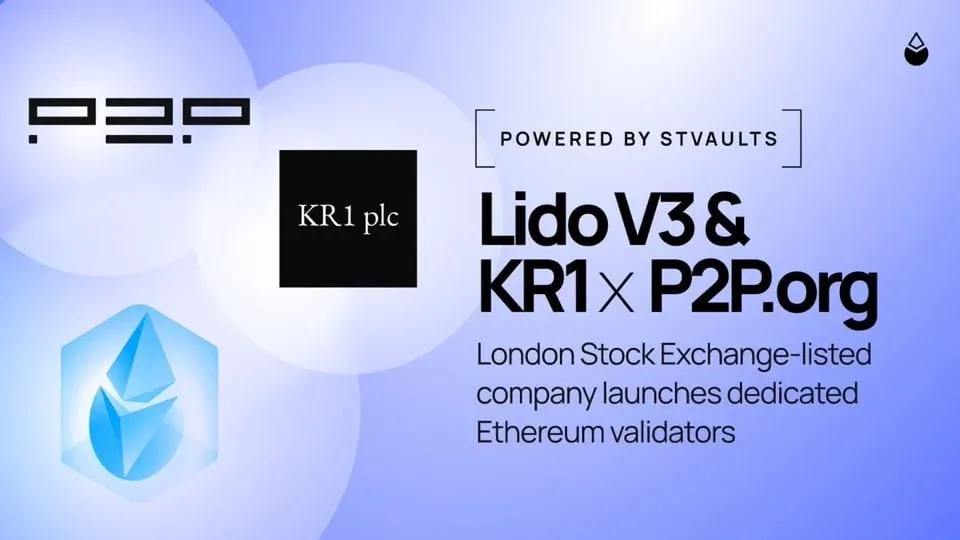
London-based KR1 initiated its plan to put the majority of its 6,200 ETH treasury to work through staking by launching 10 dedicated Ethereum validators on October 15, 2026. The London Stock Exchange-listed firm stated that this configuration aims to produce staking rewards and infrastructure income with clearer attribution than a passive Ethereum holding alone.
The initial validators operate via a dedicated Lido stVault managed by P2P.org. While KR1 intends to scale past 100 validators, that objective remains a future goal rather than the live launch scale, with the company noting that full deployment relies on the Ethereum validator entry queue.
The central question is whether KR1 can convert greater control over its staking operation into meaningful income before queue delays and operating costs shape the economics.
RNS: Launch of Dedicated Ethereum Validators
KR1 plc today announces the launch of its own dedicated Ethereum validators on @LidoFinance stVaults, in collaboration with @P2Pvalidator.
This further delivers on the broader operational strategy and reinforces KR1 as the only… pic.twitter.com/1mGHW2iC6e
— KR1 plc (@KR1plc) October 15, 2026
EXCLUSIVE: Unlock AI Trading Strategies and Best Crypto AI Trading Bots With BloFin
How Does KR1’s Dedicated Lido stVault Work?
Ethereum validators are computers that help check transactions and secure the network. In return, they can earn staking rewards and network fees. Rather than simply depositing ETH into a shared staking arrangement, KR1 has placed its validators in a dedicated Lido stVault, with P2P.org operating the validator infrastructure and Lido providing the liquid-staking middleware.
KR1 says it retains control over the vault’s settings, including deposits and withdrawals, validator fee arrangements, optional stETH minting, and roles and permissions. That control is intended to give the company more oversight of its staking operations and the income it retains after fees.
Optional stETH minting could provide liquidity while ETH is staked. In broad terms, stETH represents staked ETH and can be used in supported on-chain applications; minting it is an option in KR1’s arrangement, not a claim that the company has already done so.
For a general explanation of how Ethereum staking can generate rewards, the key distinction is that yield comes with operational and market risks as well as potential returns.
Ethereum News: What Has KR1 Launched And What Remains A Plan?
KR1’s announcement sets out a clear gap between the live deployment and its intended end state. Ten validators have launched; the company aims to scale beyond 100 and stake a large majority of its 6,200 ETH position over time.
The company said the initiative follows an operational strategy first outlined in its October 2025 prospectus.
A target of more than 100 validators is not evidence that KR1 already operates that many, and a plan to stake most of its treasury does not establish that the full 6,200 ETH is being deployed now. The RNS announcement also does not quantify expected rewards, fees, operating costs or net income, so investors cannot yet assess the economics from the disclosed figures alone.
In practice, expanding the validator set means more than moving a balance into a staking interface. Validator operations require ongoing uptime and involve risks such as downtime and slashing penalties; KR1’s announcement does not quantify those exposures.
Ethereum’s validator capacity and operating demands are part of the wider context for any expansion, but they do not establish a specific delay for KR1.
DISCOVER: 16+ New and Upcoming Binance Listings in 2026
Can 6,200 ETH Become Infrastructure Income At Scale?
KR1 presents the arrangement as a way for public-market investors to gain exposure to on-chain infrastructure income through the company. P2P.org’s Ethereum Senior Product Manager Amir Kahoori described the dedicated setup as allowing per-validator accountability without commingling funds in a shared pool. That is the operator’s characterization of the structure, not a guarantee of higher returns or zero operational risk.
Lido’s Head of Institutional Relations Kean Gilbert characterized KR1 as the first publicly listed company to launch its own branded validators on Lido stVaults. The RNS also describes P2P.org as having more than $10 billion in assets secured. They operate across more than 40 proof-of-stake networks and serving over 190 institutional clients, while reporting a zero-slashing track record.
These are company-provided background figures, not independently verified performance measures in the announcement.
The launch confirms that KR1 has started its operating model, but it does not settle how quickly the company can scale or what the treasury will earn. Broader Ethereum news may shape the environment for validator operators, but it does not substitute for KR1’s own deployment data or financial disclosures.
The next material evidence will be the pace of entry into the validator set, progress beyond the initial 10, and any figures the company provides on realized rewards and retained income.
DISCOVER: 15+ Upcoming Coinbase Listings to Watch in 2026
Frequently Asked Questions
4 questions01When did KR1 launch its dedicated Ethereum validators?
KR1 launched its initial 10 dedicated Ethereum validators on October 15, 2026.
02Who operates the underlying validator infrastructure for KR1?
P2P.org operates the validator infrastructure, while Lido provides the liquid-staking middleware through a dedicated stVault.
03How many Ethereum does KR1 hold in its treasury?
KR1 holds a total treasury of approximately 6,200 ETH, which it plans to put to work through staking over time.
04What is KR1’s long-term validator scaling goal?
The company aims to expand beyond 100 validators, though full deployment depends on the Ethereum validator entry queue.
Related stories
STRK Holders Weigh Starknet’s Post-Quantum Future
Starknet has opened a non-binding community poll allowing STRK holders to weigh in on whether the network should…
AI Predicts XRP: Stripe’s Privy Hits the Ledger and Every New Wallet Locks 1 XRP
Ripple integrates Stripe-owned Privy wallet infrastructure into the XRP Ledger, enabling AI agents and applications to automate micro-payments.…
AI Predicts SUI as Sui Buys a Whole Blockchain for $30M
The Sui Foundation commits $30 million to integrate the DATA Network into its blockchain, prompting Claude AI to…
Aptos Makes Encrypted Mempool Optional on Mainnet
Aptos has launched an optional encrypted mempool on its mainnet to protect traders and institutions from MEV attacks…