
Bitcoin ETF Paradox: NVDA Stock Has a CEO Premium That Bitcoin Never Needed
While Nvidia investors rely heavily on Jensen Huang and his commanding influence over AI, Bitcoin operates entirely without a corporate leader or CEO premium, highlighting a distinct paradox in modern Wall Street investments.

While Bitcoin investors rely on nobody, Nvidia investors have Jensen Huang, representing perhaps the most profound distinction between the two assets. Nevertheless, Wall Street has poured billions of dollars into Bitcoin ETF products, which were originally engineered to function completely without a corporate leader. Conversely, NVDA stock maintains a CEO premium directly tied to Huang’s commanding influence over the artificial intelligence sector.
Recently, Nvidia shares dropped by more than 8% in after-hours trading after its board deliberated on Huang’s future. That movement threatened to wipe out roughly $600 billion in market capitalization. Chip demand had not abruptly vanished; rather, investor confidence in Nvidia’s leader had become the core driver.
NVDA Stock and Its CEO Premium
Huang functions as much more than Nvidia’s chief executive. He acts as its primary strategist and public evangelist for the ongoing AI boom. Reuters noted that over 60 executives report directly to him, while market analysts point out that there is no obvious successor capable of replacing his influence smoothly.
Our message to Nvidia's board:
Do not fire Jensen Huang.
There is no clear replacement for Jensen Huang. We are confident that his departure would ultimately be a net negative for Nvidia, its shareholders, and the AI Revolution.
First, take a look at the data. History also…
— The Kobeissi Letter (@KobeissiLetter) November 12, 2026
Such heavy concentration drives major upside whenever investors trust the leader. Huang can easily transform a keynote address or a forecast into a market-moving catalyst. However, this also introduces vulnerability, as investors frequently find it difficult to separate the individual from the enterprise.
NVDA stock remains a symbol of ownership over the chips that form the backbone of AI infrastructure. Even so, reports hinting at a possible leadership shift proved sufficient to rattle both the stock and its business partners. This phenomenon illustrates the CEO premium—the distinct confidence that market participants place in a single person.
Apple serves as an illuminating historical precedent. Following Steve Jobs’ resignation as CEO on August 24, 2011, Apple shares dropped 5.9% in after-hours trading. Tim Cook subsequently stepped in, steering the company toward continued expansion. Apple shares have since surged by 1,946% throughout Cook’s tenure.
Yet, a distinct contrast remains. Apple possessed established succession planning alongside an operational business. Bitcoin, on the other hand, was constructed around an entirely different proposition.
DISCOVER: 15+ Best Crypto IPO to Watch in 2026
Bitcoin ETF Paradox: Wall Street Buys the Asset Without Owning Its Rules
Satoshi Nakamoto stepped away from public view years ago, yet Bitcoin continued to operate unhindered. There is no CEO to calm anxious holders, no board of directors to name a successor, and no quarterly earnings call where a founder promises an enhanced product cycle. Its issuance schedule and consensus rules operate independently of any specific personality.
Even so, Bitcoin is not entirely immune to shifts in sentiment. Its price continues to react to adoption metrics, regulatory changes, security updates, liquidity, and general demand. Nevertheless, that sentiment relies far less on any single executive. No one has to debate whether Satoshi is still performing capably in his role.
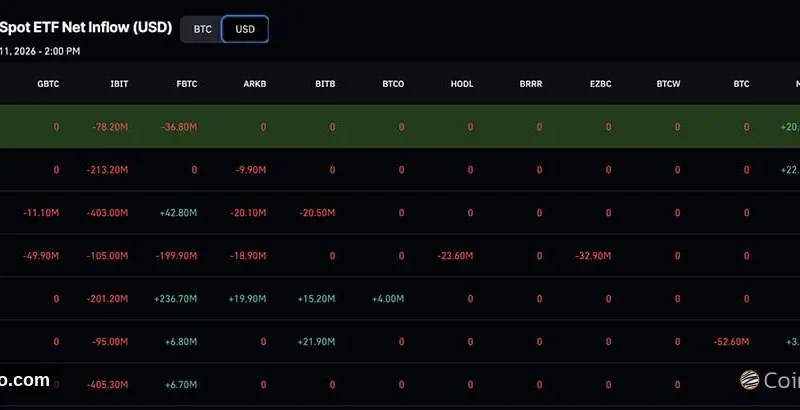
The evolution of the Bitcoin ETF market underscores how profoundly Wall Street has altered the ownership narrative. U.S. spot Bitcoin exchange-traded funds have drawn $55.4 billion in cumulative net inflows since their debut in January 2024. These investment vehicles held approximately 1.31 million BTC as of November 11, accounting for 6.5% of Bitcoin’s circulating supply of 20.11 million coins.
BlackRock’s IBIT alone held roughly 793,069 BTC by November 9, representing a value close to $59.5 billion. It provides conventional portfolios with direct exposure to Bitcoin without requiring them to navigate wallets or private-key management.
This dynamic gives rise to the Bitcoin ETF Paradox. Wall Street does not control the underlying Bitcoin protocol, yet its financial products now dictate a massive share of the market’s demand narrative. Capital inflows can amplify buying pressure, whereas redemptions can easily reverse it. Consequently, investors increasingly monitor flows into products managed by BlackRock and Fidelity to gauge institutional appetite.
Without ETFs, the landscape would look radically different. The $55.4 billion in net inflows would never have entered the asset class via these channels. Certain investors might have acquired Bitcoin directly, turned to futures contracts, or avoided the asset entirely. The 1.31 million BTC held by these funds would have belonged to alternative owners, depriving the market of a primary regulated gateway for institutional participation.

Deducting $55.4 billion from Bitcoin’s overall market value fails to accurately calculate its hypothetical ETF-free price. Market capitalization is dictated by marginal trades rather than a simple cumulative tally of every invested dollar. The true counterfactual revolves around questions of demand, accessibility, and who remains willing to buy when valuations decline.
This intersection highlights both Bitcoin’s primary advantage and its emerging vulnerability. Nvidia’s CEO premium can swiftly morph into a liability whenever trust in Jensen Huang wavers. Conversely, Bitcoin has no founder it can possibly lose.
Bitcoin never required Satoshi to keep its network functioning. Wall Street has, however, trained an entire wave of new buyers to track fund flows. While the underlying protocol remains completely decentralized, its overarching investment narrative is growing increasingly institutionalized.
DISCOVER: 15+ Upcoming Coinbase Listings to Watch in 2026
Follow 99Bitcoins on X For the Latest Market Updates, and Subscribe on YouTube For Daily Expert Market Analysis.
Frequently Asked Questions
4 questions01What is the “CEO premium” seen in NVDA stock?
The CEO premium refers to the extra confidence and market value that investors attach to a specific individual—in Nvidia’s case, Jensen Huang. His strategic vision and leadership over the AI boom heavily influence how investors price the stock, making the company vulnerable to any uncertainty surrounding his future.
02How does Bitcoin differ from companies like Nvidia regarding leadership?
Unlike Nvidia, Bitcoin has no CEO, founder, or board of directors. Its anonymous creator, Satoshi Nakamoto, disappeared years ago, meaning the network and its issuance schedule operate entirely on decentralized code without relying on any single person to maintain market confidence.
03How much capital have U.S. spot Bitcoin ETFs attracted?
Since launching in January 2024, U.S. spot Bitcoin ETFs have accumulated $55.4 billion in cumulative net inflows, holding approximately 1.31 million BTC as of November 11.
04What is the Bitcoin ETF Paradox?
The Bitcoin ETF Paradox describes how Wall Street does not control the underlying Bitcoin protocol, yet institutional financial products now drive a major portion of the market’s demand narrative and price action.
Related stories

Bitcoin Drops 11% Ahead of Anthropic IPO: Is History Repeating the SpaceX Sell-Off?
Bitcoin dropped 11.3% ahead of the upcoming Anthropic IPO, prompting analyst Benjamin Cowen to compare the move to…
Bitcoin Safe-Haven Narrative Is Falling Apart? Liquidations and ETF Outflows Wipe Out Bulls
Bitcoin's safe-haven narrative faces intense pressure as hotter inflation data sparks rate hike fears, triggering $1.28 billion in…
Elon Musk Grok AI Predicts a Huge Bitcoin Price Rally: Can it Really Go This High?
Elon Musk's Grok AI predicts Bitcoin could surge between $280,000 and $350,000 under a hypothetical scenario involving sovereign…
Strategy and Trump Media Bought the Bitcoin News: Is CPI the Trigger BTC Needs?
Despite major Bitcoin purchases by Strategy and Trump Media, Bitcoin prices fell as markets awaited the crucial U.S.…