
Spain’s Housing Pressure Puts Sánchez’s Election Strategy to the Test
Spanish Prime Minister Pedro Sánchez has called a snap general election for November 29 following a major parliamentary defeat on housing-relief measures, putting his political strategy and prediction market odds to the test.
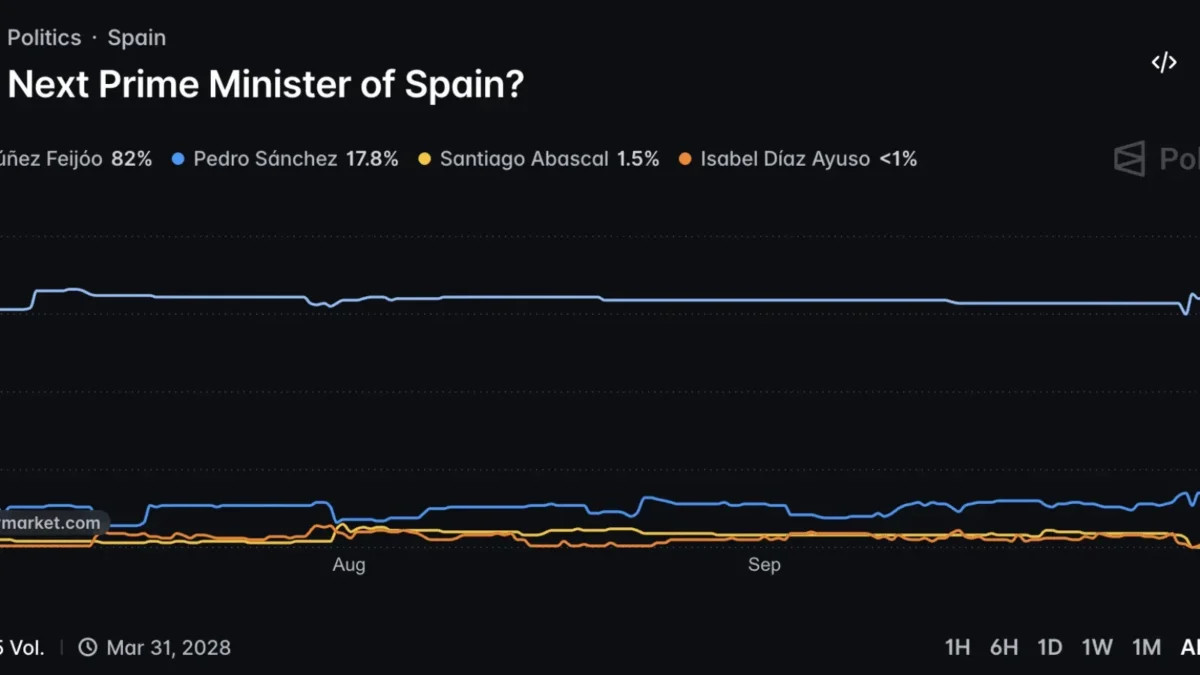
Trading odds on the Spanish election are now live following Pedro Sánchez’s decision to call a snap general election for November 29. According to Polymarket’s market snapshot, opposition leader Alberto Núñez Feijóo holds roughly an 80% chance of becoming the upcoming prime minister.
That figure represents a trader-implied probability rather than a poll result or a definitive guarantee. Because Spain operates under a parliamentary system, the next prime minister is not automatically decided simply by whichever candidate wins the most votes, and the election remains weeks away.
(SOURCE: Polymarket)
Market summaries supplied by the platform placed Feijóo between roughly 80% and 82%, while Sánchez stood at approximately 18% to 19%. These readings reflect separate snapshots instead of a single, fixed set of odds.
Market prices are frequently interpreted as probabilities, functioning much like a temperature gauge that provides a quick signal without detailing every underlying cause. Recognizing the difference between these market prices and traditional polling is vital for understanding Polymarket’s implied probabilities.
Have a Gut Feeling? It Pays on Polymarket
Spanish Election Polymarket Odds: Why did Pedro Sánchez Call an Early Election?
NEW: Pedro Sánchez has announced a snap general election for November 29
Here’s what the latest opinion polls project, compared with the 2023 election:
PP – 31.3% (-1.8) | 129 (-8)
PSOE – 26.9% (-4.8) | 106 (-15)
VOX – 19.4% (+7.0) | 69 (+36)
SUMAR – 6.3%…
— Politics Global (@PolitlcsGlobal) October 5, 2026

Sánchez announced the vote on October 5 after Parliament rejected housing-relief initiatives put forward by his minority administration. The official announcement from the Spanish government verified that the election will take place on November 29.
Housing has turned into a major political pressure point. Government officials stated that upwards of 70,000 individuals joined a housing demonstration in Madrid, whereas Idealista figures referenced in the primary coverage indicate that average rental costs have nearly doubled over the past ten years, while asking home prices have surged by approximately 90%.
Consequently, calling the election gives Sánchez an opportunity to bring housing policies and his administration’s actions directly to voters, though it directly follows a notable parliamentary defeat. The upcoming vote will evaluate whether this issue can rally greater support for his progressive coalition or if public dissatisfaction will ultimately benefit the opposition.
Discover 800+ Trading Pairs You Can Trust With Kraken
What do the Odds say About the Likely Next Government?
Within a parliamentary framework, Spanish election Polymarket odds are subject to the reality that the final outcome relies not just on the popular vote, but also on a candidate’s ability to secure an investiture vote and successfully form a government. A party can secure the most votes without automatically having a clear route to governing.
Conventional polling cited in the primary reporting points toward a potential coalition headed by the conservative People’s Party (PP), backed by Vox.
Reuters noted that a Sigma Dos survey published in El Mundo estimated a combined total of 203 seats for the PP and Vox inside the 350-seat lower house. Such an alliance would incorporate Vox into the central government for the first initial time since the death of dictator Francisco Franco.
This context helps clarify why traders have positioned Feijóo ahead. Nevertheless, prediction markets are distinct from polling averages; their prices shift as fresh information emerges, and market outcomes depend on both the specific resolution terms of the contracts and the broader political process. The current odds simply provide a snapshot of active trader positions rather than a settled final verdict on the Spanish election.
Last week, lawmakers voted down decrees including rent caps, eviction protections, and limits on corporate home purchases.
The defeat helped trigger Pedro Sánchez’s decision to… pic.twitter.com/eZwozNVPGW
— Mario Nawfal (@MarioNawfal) October 6, 2026
How Should Traders Read the Current Polymarket Price?
A price near 80 cents on a contract paying $1 if the specified event occurs is commonly interpreted as an implied probability close to 80%, prior to factoring in trading fees and other market frictions. This figure does not signify that political polls grant Feijóo an 80% share of the popular vote.
When reviewing political contracts, readers can apply this identical distinction—separating a market snapshot from an official forecast—when analyzing other contests like Brazil election odds or Senate election markets.
These odds remain informational, vulnerable to volatility, and do not constitute investment advice. They do not guarantee who will emerge victorious on November 29 or who will ultimately assume the role of prime minister, as prices remain subject to change alongside shifting polls, campaign events, and coalition possibilities.
Frequently Asked Questions
4 questions01When is the Spanish general election scheduled to take place?
The snap general election called by Prime Minister Pedro Sánchez is scheduled for November 29.
02Why did Pedro Sánchez call an early election?
Sánchez called the snap election after Parliament voted down housing-relief measures proposed by his minority government, bringing housing pressure to the forefront of national politics.
03What do Polymarket odds indicate about Alberto Núñez Feijóo?
Polymarket’s market snapshot places opposition leader Alberto Núñez Feijóo at roughly 80% to 82% to become the next prime minister, reflecting trader-implied probabilities rather than official poll results.
04Does winning the most votes guarantee leadership in Spain’s government?
No. Because Spain uses a parliamentary system, the next prime minister is determined by who can successfully secure an investiture vote and form a government, meaning the party with the most votes does not automatically have a guaranteed path to rule.
Related stories
A Decade-Old Ripple XRP Ledger Flaw Was Patched Before Disclosure
An XRP Ledger vulnerability could have created extra spendable XRP, but Ripple says it was patched before disclosure…
AI Crypto Tokens Take South Korea by Storm, Overtaking Ripple XRP
Artificial intelligence cryptocurrencies have surged to become South Korea's top crypto sector by June 2026, overtaking payment assets…
Ethereum News: Glamsterdam Test Leaves Validator Strain Unresolved
Ethereum's Glamsterdam upgrade has elevated Sepolia's block-gas limit to nearly 200 million, though questions remain regarding validator strain…

Bitcoin Privacy Faces New Questions Over HMRC Crypto Powers
HM Revenue and Customs is considering expanded information-gathering powers over UK crypto businesses, sparking privacy concerns because linking…