
Bitcoin Price Struggles Under $65K as World Bank Explores USDC Rails: Follow the Dollar Liquidity?
Bitcoin struggles below $65,000 amid ETF outflows, while the World Bank and Citi explore Circle's USDC to streamline international development funds using blockchain-powered payment rails and improve transparency.

Bitcoin’s valuation remains under downward pressure, continuing to trade below $65,000. Meanwhile, fresh institutional movement is emerging within the stablecoin sector. The World Bank Group is currently evaluating Circle’s USDC in collaboration with Citi to handle development funds through blockchain-powered payment rails.
The 82-year-old financial institution aims to assess whether regulated stablecoins can streamline international disbursements by making them more transparent, affordable, and rapid. The proposed framework pairs Circle’s USDC settlement architecture with Citi’s established banking footprint. This new project expands upon FundsChain, an existing World Bank blockchain platform that currently spans more than 350 initiatives across 96 nations.
This development unfolds as the Bitcoin price struggles to rebound following a significant market downturn, accompanied by US spot Bitcoin ETFs registering an additional $239.9 million in net outflows yesterday. Even so, institutional integration of blockchain-based dollar transactions continues to grow.
The key question now is whether the escalating migration of dollars onto blockchain networks will ultimately supply an alternative source of liquidity for Bitcoin.
DISCOVER: 15+ Best Crypto IPO to Watch in 2026
World Bank Turns to Circle’s USDC for Global Payments
The World Bank Group disclosed its exploration last night, uniting two prominent financial infrastructure pillars. Circle supplies the stablecoin framework required to mint and clear transactions in USDC, while Citi bridges those transactions into traditional correspondent banking channels.
CONFIRMED: The World Bank Group is exploring CRYPTO dollars to pay out its funds, using Circle's $USDC with Citi.
The 82-year-old lender will test whether USDC can move development money faster and cheaper than today's bank-to-bank transfers.
Its blockchain platform FundsChain… pic.twitter.com/Yz9bGObXQ8
— Coin Bureau (@coinbureau) November 18, 2026
The primary goal is to enhance the delivery of development finance to local initiatives, businesses, and governments. Traditional cross-border transactions frequently encounter settlement delays, administrative processing windows, and multiple intermediary banks. Adopting blockchain settlement helps mitigate these hurdles by speeding up transaction execution.
Citi notes that its global network links clients spanning upwards of 180 jurisdictions. The institution seeks to implement round-the-clock payment capabilities to ensure vital funds move instantly. Furthermore, Circle CEO Jeremy Allaire highlighted development finance as a vital use case for internet-native money.
“Circle is building the infrastructure for an internet-native financial system, and development finance is one of its most important applications.” – Circle CEO Jeremy Allaire
This initiative builds on top of FundsChain, which already brings added visibility to World Bank development efforts. Digital ledgers enable all involved parties to monitor how project capital is utilized. Currently, the platform oversees more than 350 projects across 96 countries.
The financial scale involved is substantial. The World Bank Group issued $123.5 billion worth of grants, loans, equity investments, and guarantees throughout fiscal 2026. This newly launched exploration could eventually integrate stablecoin settlements deeply into an immense institutional network.
That said, the initial testing phase will focus strictly on borrower nations where digital assets are legally permitted. Additionally, the World Bank intends to deploy an interoperable and intermediated payment framework that ties blockchain tech back to legacy financial systems.
DISCOVER: 15+ Upcoming Coinbase Listings to Watch in 2026
Bitcoin Price Could Benefit From Expanding Dollar Liquidity
USDC has established itself as a leading dollar-pegged asset operating across distributed ledger networks. Circle reported an average USDC circulation amounting to $73.3 billion over Q3 2026, alongside on-chain transfer volumes hitting $13.9 trillion—marking a 49% year-over-year increase.
Recent earnings disclosures from Circle also revealed that USDC accounted for 79% of total stablecoin transaction volume, contrasted with its 27% share of overall stablecoin supply. This disparity underscores how actively USDC circulates across decentralized financial ecosystems.
This dynamic matters because stablecoins supply a significant portion of the dollar liquidity driving digital asset markets. Participants utilize USDC to position trades, transfer funds between platforms, and finalize settlements. Broader institutional adoption will likely expand the underlying plumbing that powers these operations.
As the premier cryptocurrency, Bitcoin remains a primary destination for digital asset allocation. More accessible stablecoin pathways could simplify the process for market participants and institutions looking to shift capital into cryptocurrency markets, creating a potential secondary tailwind for Bitcoin’s price and market liquidity.
The current timing is particularly notable given prevailing market conditions. Bitcoin’s price sits below $65,000, and US spot Bitcoin ETFs experienced $239.9 million in redemptions on November 17, with BlackRock’s IBIT alone responsible for $209.5 million of those outflows.
The juxtaposition between cooling retail/ETF demand for Bitcoin and expanding institutional stablecoin infrastructure prompts a compelling question: Could the upcoming wave of crypto liquidity originate from traditional finance entities migrating US dollars onto blockchain rails?
Follow 99Bitcoins on X For the Latest Market Updates, and Subscribe on YouTube For Daily Expert Market Analysis.
Frequently Asked Questions
5 questions01Why is the World Bank exploring USDC?
The World Bank Group is testing Circle’s USDC with Citi to determine if regulated stablecoins can make international development fund disbursements faster, cheaper, and more transparent compared to traditional bank-to-bank transfers.
02What is FundsChain?
FundsChain is the World Bank’s existing blockchain platform that provides transparency and tracking for project funds. It currently covers more than 350 projects across 96 countries.
03How much money does the World Bank disburse?
During fiscal 2026, the World Bank Group delivered $123.5 billion in loans, grants, equity investments, and guarantees.
04How is the Bitcoin price performing?
Bitcoin is currently trading under pressure below $65,000, coinciding with net outflows from US spot Bitcoin ETFs.
05Could stablecoins help Bitcoin liquidity?
As traditional financial institutions move dollars onto blockchain rails via stablecoins like USDC, it creates an expanding pool of digital dollar liquidity that could make it easier for capital to flow into cryptocurrencies like Bitcoin.
Related stories

Bitcoin ETF Sellers Show No Mercy: BlackRock Leads $582M Bitcoin ETF Exodus as BTC Hits New Lows
US spot Bitcoin ETFs suffered a net loss of $582 million as BTC dropped below $62,000, led by…
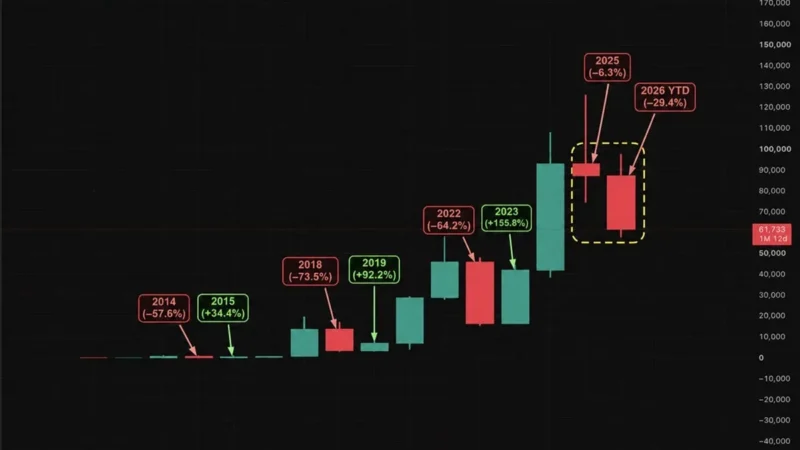
Bitcoin Price Has Never Had Two Red Years in a Row: 4-Year Cycle Broken?
Bitcoin price is heading toward an unprecedented moment in its trading history. Bitcoin has fallen 30% in 2026,…
Perplexity AI Predicts Insane Bitcoin Price Target for 2027
What if Bitcoin’s next major rally isn’t just another cryptocurrency bull run, but the start of a fundamental…

Bitcoin Nears $62,862 Mining Cost: Will BTC Price Hold Above This Level or Break Below It?
Bitcoin is nearing its $62,862 average mining cost, raising questions about whether the cryptocurrency can hold above this…