
Bitcoin Price Rebound Faces a Fresh $82K Test: Will It Survive the Weekend?
Bitcoin price rebounds after leveraged selling, but ETF inflows and macro pressure leave the recovery unconfirmed near the $80,000 support zone. The post Bitcoin Price Rebound Faces a Fresh $82K Test: Will It Survive the Weekend? appeared first on 99Bitcoins.

The Bitcoin exchange rate currently sits at $81,965, marking a 2.47% increase over the past 24 hours, though it recently dipped back under the $82,000 threshold that it had successfully reclaimed earlier Friday morning. This recovery came in the wake of US inflation hitting 3.7%, alongside a sharp shift in Treasury yields and a massive purge of leveraged long contracts.
That particular price zone holds significantly more weight than a typical psychological milestone. According to Avinash Shekhar, the co-founder and chief executive officer of Pi42, the $82,000 mark has functioned as both a floor and a ceiling for nearly 50 days, rendering any weekend close relative to this level highly meaningful.
Trade Securely With 0% Trading Fees on MEXC
BTC USD Back Above $80K: What the Rebound Was Actually Built On
Thursday’s pullback to approximately $79,800 eradicated roughly $930 million worth of leveraged positions, with long positions accounting for about $780 million of that total. During the subsequent relief rally, roughly $53 million in short positions were cleared out.
That second metric deserves attention. While short squeezes can drive prices upward rapidly, they merely close existing positions rather than generating fresh organic demand, indicating that part of the weekly recovery was driven by market mechanics rather than net new buyers.
Order book dynamics paint a similar picture. Heatmaps from Glassnode revealed a heavy wall of buy orders resting at $80,000 for a large portion of last week. Those orders were fully absorbed during Thursday’s downturn, and the replacement buy stack that formed underneath was notably smaller than its predecessor.
Conversely, opposing indicators exist. CryptoQuant’s metric tracking total whale reserves—which excludes addresses tied to exchanges and mining pools—has risen steeply since September and now hovers near three million BTC, matching its peak levels for 2026. These major wallets continued accumulating coins while prices dropped.
New Whales Now Account for 1/3 of Bitcoin’s Whale Realized Cap
“At $82,134, Bitcoin trades about 6.7% above new whales’ cost basis.” – By @MorenoDV_ pic.twitter.com/B7SREdQdTU
— CryptoQuant.com (@cryptoquant_com) October 16, 2026
A separate detail suggests caution is warranted. Trading volume contracted by 23.87% down to $30.98 billion while prices rebounded, meaning the upward move materialized on significantly lighter participation than the sell-off that preceded it.
DISCOVER: Best Meme Coin ICOs to Invest in 2026
BTC Levels Into the Weekend: Can Bitcoin Price Hold The Line?
Riya Sehgal, a research analyst at Delta Exchange, identifies the critical support band between $80,000 and $80,700. A definitive breach beneath this zone would leave the $78,000 to $79,500 region vulnerable, whereas reclaiming the $82,000 to $83,200 range is necessary to strengthen the near-term technical structure.
The trajectory of BTC USD will be determined by these specific levels:
- The floor: $80,000 to $80,700. This area has successfully held off bears twice this week. Data from Glassnode indicates that underlying bids are thinner than before, meaning a third test would encounter less resistance depth.
- The pivot: $82,000. It has served as both support and resistance for nearly 50 days. Friday’s fade back beneath it leaves the weekend outcome wide open.
- The recovery zone: $82,000 to $83,200. Maintaining positions above this specific band is what transforms a temporary bounce into an established trend reversal.
Market repricing has pushed volatility up by about 7% toward 39, and weekend trading periods inherently feature reduced liquidity. This combination frequently generates exaggerated price swings on lower volume in either direction.
The broader macroeconomic environment remains challenging as well. September consumer price inflation came in at 3.7% alongside a 6.3% rise in producer prices—both figures exceeding forecasts—while the Federal Reserve prepares for an October 29 meeting where a rate hike remains possible.
Traders should focus on the closing price rather than intraday wicks. Bitcoin has spent the past week oscillating between two boundaries, and this weekend marks the first interval where neither traditional equity markets nor incoming US economic data will dictate market direction.
DISCOVER: 15+ Upcoming Coinbase Listings to Watch in 2026
Follow 99Bitcoins on X For the Latest Market Updates and Subscribe on YouTube For Daily Expert Market Analysis.
Frequently Asked Questions
4 questions01Why is the $82,000 level so important for Bitcoin?
According to analysts like Pi42 co-founder Avinash Shekhar, the $82,000 mark has acted as both a crucial support and resistance level for nearly 50 days, making any weekend close around this price point a strong indicator of future direction.
02What caused Bitcoin’s recent price drop?
Thursday’s drop to approximately $79,800 was triggered by US inflation coming in at 3.7%, a sharp move in Treasury yields, and a major flush of leveraged long positions that wiped out roughly $930 million in derivatives.
03What are the critical support levels to watch?
Analysts point to the $80,000 to $80,700 region as the primary floor. If that support fails, the price could drop toward the $78,000 to $79,500 range.
04How are large holders (whales) behaving during this volatility?
CryptoQuant data shows that total whale holdings—excluding exchanges and mining pools—have climbed steeply since September, sitting near three million BTC and close to their highest levels of 2026 as large wallets accumulated during the price drop.
Related stories
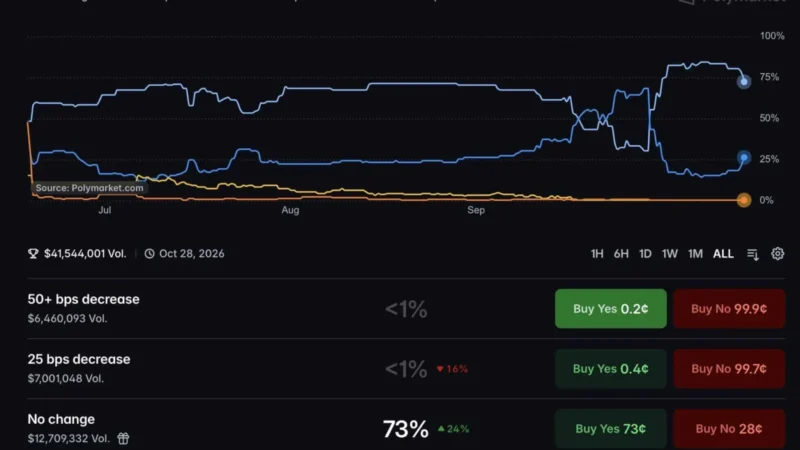
Will a Fed Hold Ease Bitcoin Pressure as Hike Bets Rise Toward December?
Polymarket traders price a 73% probability that the Federal Reserve will pause interest rates during its October meeting,…
SEC Approves Binary Options on Coinbase and MARA Metrics, but Not a Bet on Bitcoin’s Price
SEC approval creates a framework for Coinbase and MARA binary options, but leaves launch timing, liquidity, trading depth…
Miners Must Find New Pools Before Binance’s November Cutoff
Binance Pool is scheduled to shut down on November 10, 2026, forcing miners to redirect their hardware and…
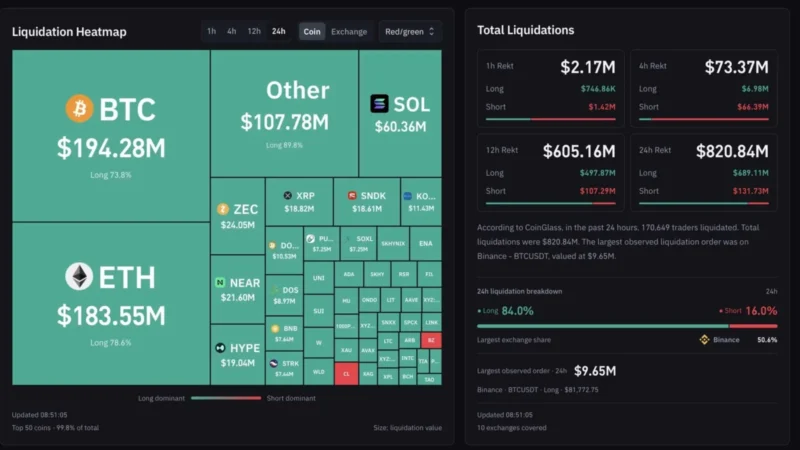
BTC USD Survives an $820M Liquidation Bloodbath: Can Bulls Handle CPI Next?
BTC USD suffered an $820M liquidation bloodbath as prices dipped to $81,000 before recovering. With upcoming US CPI…