
Bitcoin Core Bugs Emerge as Fed Holds Rates and Traders Brace for $12B Expiry
Developers revealed three Bitcoin Core vulnerabilities discovered through AI-assisted security investigations, coinciding with the Federal Reserve holding interest rates steady and traders preparing for a $12 billion options expiry.
Fresh macroeconomic uncertainty coincides with the sudden discovery of Bitcoin Core bugs. Developers revealed three separate vulnerabilities on October 28, following AI-assisted security investigations conducted by Project Loupe. These disclosures emerged just hours after the Federal Reserve opted to hold interest rates steady, directing market attention squarely toward Friday’s upcoming $12 billion Bitcoin options expiry.
BREAKING: Three new Bitcoin Core vulnerabilities discovered including a bug allowing attackers to remotely brick nodes.
The vulnerabilities include two medium-severity flaws that could allow malicious peers to exhaust node memory and a third that could corrupt blockchain undo… pic.twitter.com/oOx2rrK8xe
— Rod Palmer
(@rodpalmerhodl) October 28, 2026
The affected software is Bitcoin Core, which functions as the primary network utility utilized by nodes to enforce rules and verify transactions. One particular flaw leaves nodes operating on Windows, macOS, and BSD vulnerable to remote crashes triggered by malicious peers. Another bug can systematically deplete node memory, while a third risks corrupting blockchain undo data under extraordinary conditions.
Fixes have already been distributed by Bitcoin Core maintainers across four active release branches. Nevertheless, the simultaneous appearance of these issues introduces network security concerns alongside shifting monetary policy and heavy derivatives positioning during an already hectic week.
DISCOVER: 15+ Best Crypto IPO to Watch in 2026
Bitcoin Core Bugs and Node Security
The most severe vulnerability centers on unbounded memory expansion driven by TCP urgent data. Through this method, a malicious peer can bypass standard memory safety boundaries to overwhelm nodes running operating systems other than Linux (Linux nodes are unaffected).
A second flaw enables incremental memory consumption when an inbound or outbound peer simulates the use of an older Bitcoin protocol. By leveraging vulnerabilities in connection management and message queuing, an attacker can continuously accumulate data. Bitcoin Core assesses the resulting rate of growth to be approximately 2 MB per hour for each inbound peer and up to 5 MB per hour for each outbound peer.
The third issue involves oversized undo files, which house the data required to reverse blocks during network reorganizations. Under rare circumstances, a miner could generate valid blocks forcing an undo file past the 4 GB limit. The resulting data corruption might prompt targeted nodes to shut down during specific reorganizations. While patches address 64-bit systems, 32-bit platforms and nodes relying on FAT32 storage remain vulnerable.
All three security gaps were categorized as straightforward to uncover using basic techniques, such as large language model prompts. Automated AI scanning executed by Project Loupe—led by Elias Rohrer at Spiral—brought these bugs to light. Updated disclosure guidelines for Bitcoin Core allow for accelerated publication whenever patches are finalized for flaws deemed simple to locate.
Fed Holds Rates as Bitcoin Options Expiry Approaches
On October 28, the Federal Reserve kept its benchmark interest rate unchanged at 3.75%–4.00%. The vote was divided, however, with officials Lisa Cook and Beth Hammack advocating for a 25-basis-point rate hike. Furthermore, the official FOMC statement characterized economic growth as robust while noting that inflation levels remain high.
Read Chairman Warsh's full opening statement from the #FOMC press conference (PDF): https://t.co/TPqQ7MKO7m pic.twitter.com/1SUkOfaU0T
— Federal Reserve (@federalreserve) October 28, 2026
This decision forces markets to balance persistent inflation indicators against the trajectory of future central bank policy. Elevated interest rates often weigh on risk assets by raising borrowing expenses and boosting the appeal of yield-generating alternatives. Ultimately, Bitcoin’s price response will be shaped by market liquidity, trading positioning, and expectations regarding upcoming Fed actions.
Simultaneously, roughly $12 billion worth of Bitcoin options are slated to expire tomorrow. Derivatives metrics place the total notional value near $12.4 billion, establishing this settlement as a crucial milestone for near-term market positioning. Traders will closely examine the balance of puts and calls alongside critical strike prices as these contracts expire.
An options expiry does not guarantee an immediate market rally or steep sell-off. Nevertheless, substantial pools of open interest can heavily impact hedging routines and amplify price swings whenever market conditions shift. Merged with the aftermath of the Fed’s rate decision, this derivatives event gives investors ample reason to track volatility closely.
Notwithstanding these short-term headwinds, Bitwise Chief Investment Officer Matt Hougan has upgraded his long-term Bitcoin forecast to $1.6 million by 2036. His latest investment outlook emphasizes accelerating store-of-value adoption and an expanding institutional investment landscape.
Hougan’s projection relies on the premise that Bitcoin will secure a larger portion of these growing markets over the course of the next decade.
DISCOVER: 15+ Upcoming Coinbase Listings to Watch in 2026
Follow 99Bitcoins on X For the Latest Market Updates, and Subscribe on YouTube For Daily Expert Market Analysis.
Frequently Asked Questions
5 questions01What caused the newly discovered Bitcoin Core vulnerabilities?
The three vulnerabilities were identified through automated AI-assisted security research conducted by Project Loupe, led by Elias Rohrer at Spiral, using methods that included large language model prompts.
02Which operating systems are affected by the TCP urgent data memory flaw?
The most serious flaw allowing unbounded memory growth affects nodes running non-Linux operating systems such as Windows, macOS, and BSD. Linux nodes are not impacted by this specific issue.
03What was the outcome of the Federal Reserve’s October 28 meeting?
The Federal Reserve decided to maintain its benchmark interest rate at 3.75%–4.00%, though the vote was not unanimous as two officials favored a 25-basis-point rate hike.
04How large is the upcoming Bitcoin options expiry?
Around $12 billion in Bitcoin options are scheduled to expire, with derivatives estimates placing the notional value near $12.4 billion.
05What is Matt Hougan’s long-term price target for Bitcoin?
Bitwise Chief Investment Officer Matt Hougan has set a long-term Bitcoin target of $1.6 million by 2036, driven by growing store-of-value demand and institutional market expansion.
Related stories

BTC USD Fell in the Month After 12 of the Fed’s 16 Rate Hikes Since 2018: What Could a December Hike Mean for Bitcoin?
Bitcoin has fallen thirty days after twelve of the Federal Reserve’s sixteen rate hikes since 2018, as traders…
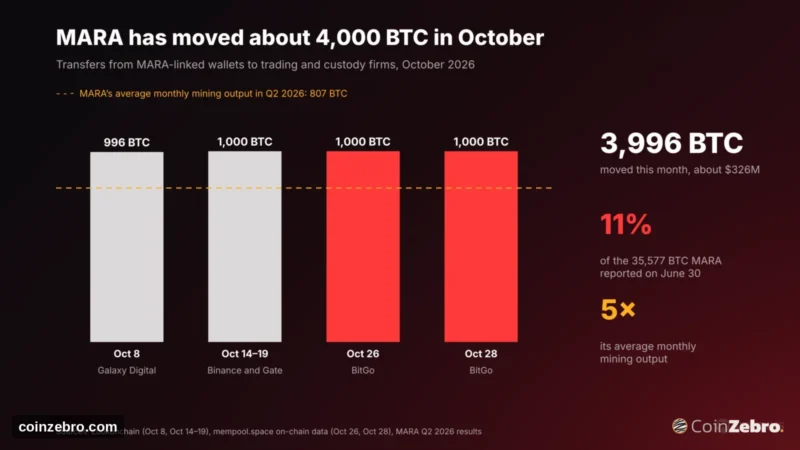
MARA Sends Another 1,000 BTC to BitGo, Its Fourth Big Transfer in October: Can BTC USD Absorb It?
Bitcoin miner MARA Holdings transferred another 1,000 BTC to custodian BitGo, marking its fourth major transfer in October…
Bitcoin FOMC Hopes Hang in the Balance as Oil Surges and Ukraine Seeks Peace
Bitcoin climbed toward $81,000 as markets braced for the latest FOMC interest rate decision. Digital assets contend with…
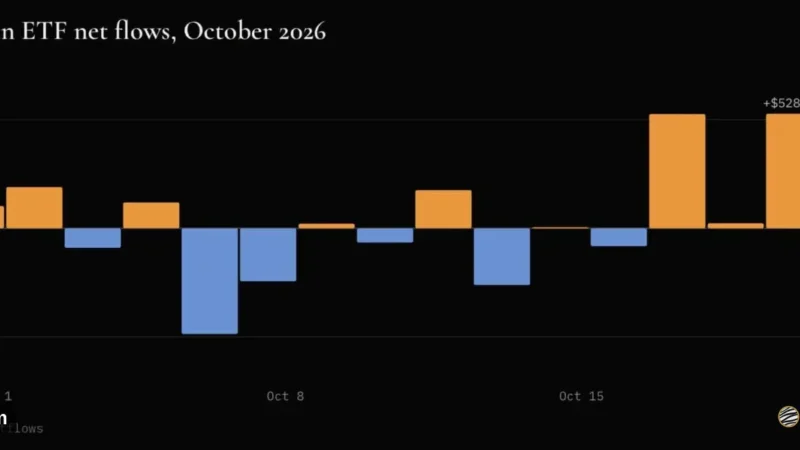
Bitcoin ETFs Own Just 8.5% of BTC as IBIT Ends a Two-Day Outflow Run: Can BTC USD Hold $79,200?
Bitcoin ETFs command just 8.5% of tradable BTC as BlackRock's IBIT ends a multi-day outflow run with a…