
JPMD Reaches Base for Institutional On-Chain Cash
JPMorgan is expanding its tokenized dollar deposit, JPM Coin, from Base to the Ethereum mainnet, providing approved institutional clients with native on-chain cash for cross-network settlements and collateral management.
The most significant Ethereum development of the day originates from Wall Street rather than a developer gathering. JPMorgan is expanding its tokenized dollar deposit, JPM Coin (JPMD), from Base to the Ethereum mainnet. In a statement released on Monday, the bank’s blockchain division, Kinexys, announced that JPMD now supports cross-network transfers across Ethereum Virtual Machine networks, including both Base and Ethereum.
User access conditions remain unchanged. Because JPMD is restricted exclusively to approved institutional clients, retail investors cannot buy a new coin. The update instead broadens the physical environments where the bank’s capital can travel.
News: JPM Coin (JPMD), @jpmorgan's USD deposit token, is now live on @ethereum.
JPMD extends from Base to Ethereum L1, giving institutional clients native onchain cash that sits alongside the assets, collateral and counterparties they transact with already.
J.P. Morgan has now… pic.twitter.com/fNYAGoT3Pb
— Ethereum Institutional (@ethereuminsti) October 19, 2026
EXCLUSIVE: Unlock AI Trading Strategies and Best Crypto AI Trading Bots With BloFin
Why Did JPMorgan Pick Ethereum After Base?
The decision came down to liquidity. Kinexys cited Ethereum’s “established depth of onchain liquidity and tokenized assets” as the driving factor that made it the logical next network. Emma Landriault, the global head of Kinexys Labs, shared with Bloomberg that crypto businesses could utilize JPMD for transactions, whereas financial institutions could employ the asset to settle trades or post collateral for tokenized holdings.
Tokenized financial infrastructure is no longer theoretical
The financial institution has built toward this milestone incrementally. JPMD debuted on Coinbase’s Ethereum layer 2 network, Base, in November 2025 following a pilot phase that launched that June alongside participants like Coinbase, Mastercard, and B2C2 testing issuance and redemption. Subsequently, JPMorgan deployed its inaugural tokenized money-market fund on Ethereum in December 2025, followed by a second fund, JLTXX, in May. Additionally, Digital Asset and Kinexys announced in January that JPMD would natively arrive on the Canton Network over the course of 2026.
By way of context, Kinexys reports processing more than $4 trillion since its inception, with daily averages sitting near $7 billion. That figure measures overall platform volume and does not reflect JPMD metrics specifically. JPMorgan has not revealed the exact volume of JPMD currently in circulation, and Monday’s statement omitted a mainnet contract address as well as an official go-live date.
DISCOVER: 10+ Next Crypto to 100X In 2026
Ethereum News: What Is JPMD, and Who Can Use It?
JPMD represents a bank deposit transformed into a digital token format. Every single token functions as a claim against US dollars maintained at JPMorgan, backed directly by the bank’s balance sheet, and possesses the capability to generate interest. Conversely, a stablecoin like USDC operates as an independent asset created by a separate entity and supported by a reserve pool.
That structural difference forms the core of the value proposition. Kara Kennedy, global co-head of Kinexys, noted during the Singapore Fintech Festival last November that tokenized deposits receive more straightforward regulatory capital and accounting classifications compared to newer forms of digital currency. Commercial banks can document them identically to standard deposits.
The token also maintains permissioned controls. Participants maintain holdings through Blockchain Deposit Accounts, ensuring that only vetted clients can accept or transfer the asset, even when operating on an open network like Ethereum.
The rationale for deploying on a public blockchain centers on programmable money that operates around the clock. Kennedy highlighted Kinexys’s intraday repo solution, which allows repurchase agreements to be initiated and finalized down to the minute. A repo functions as a short-term lending arrangement where one party provides assets in exchange for cash and commits to reversing the swap later. Compressing this turnaround duration from multiple days down to minutes frees up liquidity that banks would otherwise reserve as a buffer.
Kennedy does not anticipate traditional financial rails disappearing entirely. She projects that public and private blockchains will operate parallel to legacy banking frameworks for years, if not decades, though she expects tokenized finance to look drastically different within five to ten years.
Transfer rules for regulated digital tokens illustrate how compliance requirements can be built into token infrastructure.
What Does JPM Coin on Ethereum Mean for ETH Price?
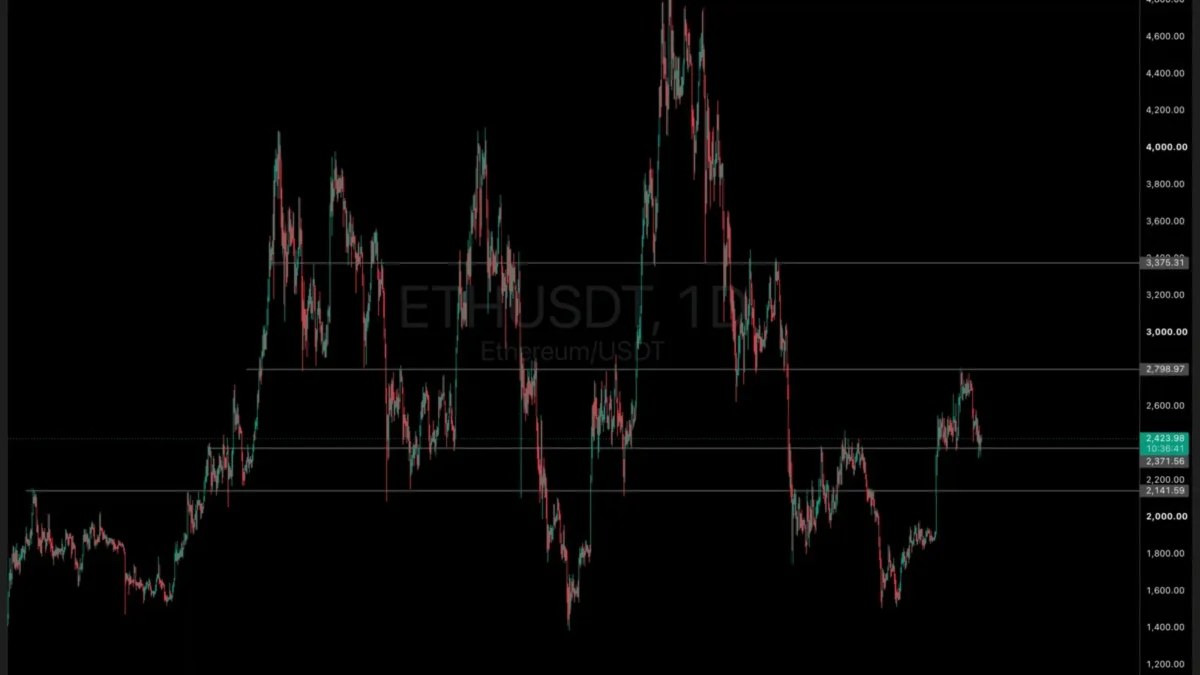
ETHUSDT Chart 1D TradingView
The immediate market impact is minimal. ETH trades at $2,423, marking a 0.14% increase over a 24-hour window alongside a 4.94% decline across the week, while the Ethereum news made virtually no splash on the price charts. JPMD transactions incur gas fees paid in ETH just like standard network transfers, but the token itself will not enter retail investor portfolios.
The broader narrative centers on the rising need for blockspace. Nearly $50 billion sits locked within Ethereum decentralized applications, according to DefiLlama data, and each financial institution settling transactions on the mainnet reinforces the argument that Ethereum serves as the primary home for tokenized finance.
On daily technical charts, ETH is positioned between its 50-day exponential moving average (EMA) of $2,483.81 and its 200-day EMA of $2,314.14. A successful daily close above the 50-day indicator brings $2,546.66 into focus, whereas a drop below $2,371 puts the 200-day EMA next in line.
Wall Street continues its migration on-chain one deposit at a time, even if price action requires more time to acknowledge the shift.
DISCOVER: Best Meme Coin ICOs to Invest in 2026
Follow 99Bitcoins on X For the Latest Market Updates and Subscribe on YouTube For Daily Expert Market Analysis.
Frequently Asked Questions
4 questions01What is JPMD?
JPMD (JPM Coin) is JPMorgan’s tokenized US dollar deposit. Each token represents a claim on US dollars held at JPMorgan, is backed by the bank’s balance sheet, and can pay interest.
02Who is allowed to use JPMD?
JPMD is strictly for approved institutional clients. Retail investors cannot buy or hold the coin.
03Which networks does JPMD support?
JPMD supports cross-network transfers across Ethereum Virtual Machine (EVM) networks, including both Base and the Ethereum mainnet.
04How does JPMD differ from a stablecoin like USDC?
A stablecoin like USDC is a separate asset issued by an independent company and backed by a reserve, whereas JPMD is a direct bank deposit claim backed by JPMorgan’s balance sheet.
Related stories
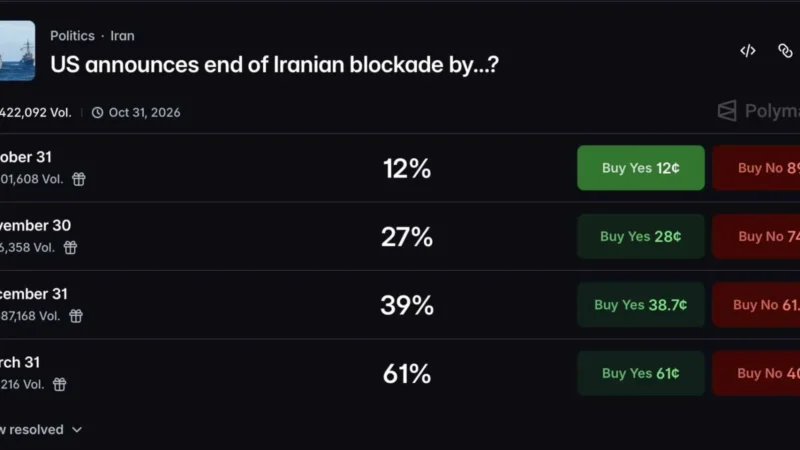
Iran War Polymarket Odds: 60% See Blockade End by March
Polymarket betting data shows traders assign a 61% probability that the United States will formally announce the termination…
Toncoin Sends Delayed on Coinbase: Is the TON Network Down?
Coinbase warns customers of delayed Toncoin sends on the TON Network, restricting asset withdrawals while buys, sells, and…
Ten Validators Put KR1’s Ethereum Staking Plan Into Practice
London-based KR1 launched ten dedicated Ethereum validators using a Lido stVault managed by P2P.org, initiating a plan to…
STRK Holders Weigh Starknet’s Post-Quantum Future
Starknet has opened a non-binding community poll allowing STRK holders to weigh in on whether the network should…